
The transport of dangerous goods by road within Europe is regulated by the ADR agreement (“Accord relatif au transport international des marchandises Dangereuses par Route”). One of the most important safety principles within ADR is the correct marking and labeling of packages containing dangerous goods. Proper labels, UN numbers, orientation arrows and additional markings allow everyone involved in the transport chain — from warehouse personnel and drivers to emergency responders and inspection authorities — to immediately recognize the hazards associated with a package.
Incorrect or missing labels are among the most common non-conformities found during ADR inspections. They can lead not only to enforcement action and fines, but also to serious safety risks during loading, transport, storage or emergency response situations.
This article explains the main ADR requirements regarding labels, UN markings, Limited Quantity (LQ) marks, orientation arrows and other mandatory package markings.
ADR Hazard Labels on Packages
ADR requires that packages containing dangerous goods are fitted with hazard labels corresponding to the classification of the substance or article being transported.
According to ADR 5.2.2.2.1.1.2, hazard labels must have the shape of a square set at an angle of 45 degrees, creating a diamond or rhombus shape. The standard dimensions are at least 100 mm x 100 mm.
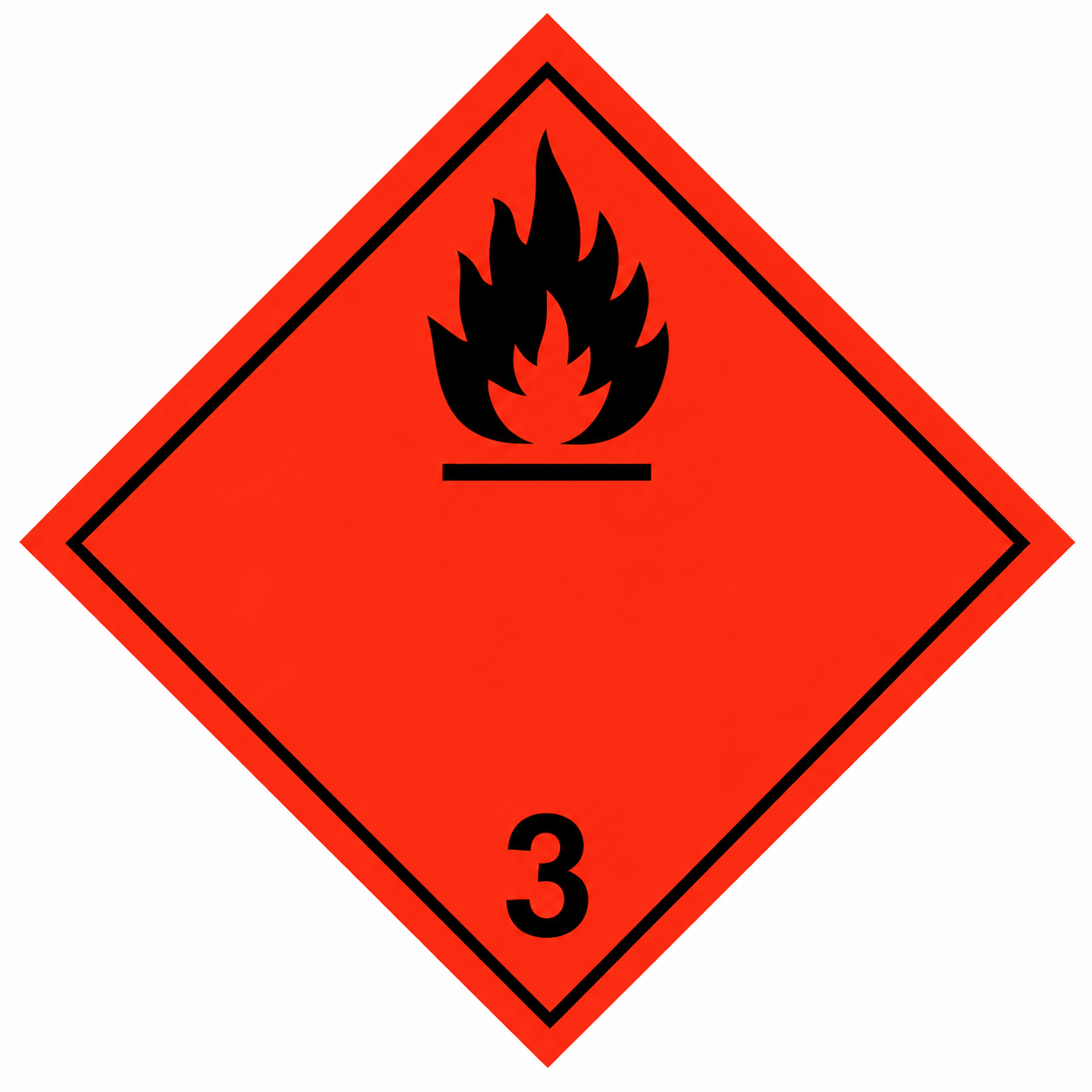 Inside the outer border there must be a line running parallel to the edge of the label at approximately 5 mm from the outer edge. The upper half of the label normally contains the hazard symbol, while the lower half displays the class number or subclass number.
Examples include:
- Class 3 flammable liquid labels
- Class 8 corrosive labels
- Class 6.1 toxic labels
- Class 2 gas labels
- Class 9 miscellaneous dangerous goods labels
The colors, symbols and numbers must remain clearly visible and durable during transport.
Reduced Label Sizes
ADR recognizes that some packages are too small for standard-sized labels. Under ADR 5.2.2.2.1.1.3, the dimensions of the label may be proportionally reduced provided that the label remains clearly visible and legible.
This is especially relevant for:
- small combination packages,
- cylinders,
- laboratory packaging,
- medical packaging,
- limited quantity packaging.
Even when reduced in size, the label must still maintain its characteristic shape, symbol visibility and contrast.
Labeling Requirements for IBCs and Large Packagings
Intermediate Bulk Containers (IBCs) with a capacity exceeding 450 liters and large packagings must display hazard labels on two opposite sides.
This requirement ensures visibility regardless of the direction from which the packaging is approached during handling, storage or emergency response operations.
UN Number Marking Requirements
Unless specifically exempted by ADR, every package containing dangerous goods must display the corresponding UN number.
The UN number must:
- be preceded by the letters “UN”,
- be clearly visible,
- be durable,
- correspond to the dangerous goods inside the package.
Examples:
- UN 1090 Acetone
- UN 1203 Gasoline
- UN 1789 Hydrochloric Acid
The minimum character height is generally 12 mm.
ADR allows reduced character sizes for smaller packagings:
- minimum 6 mm for packages of 30 liters or less, packages not exceeding 30 kg gross mass, and cylinders with a water capacity of 60 liters or less;
- smaller dimensions may be acceptable for packages of 5 liters or 5 kg or less if appropriately proportioned.
Gross Mass Marking Above 50 kg
Every package with a gross mass exceeding 50 kg must display the maximum permissible gross mass clearly and durably on the outside of the package.
This requirement is intended to improve safe handling during loading and unloading operations and to reduce manual handling risks.
Orientation Arrows (“This Way Up” Markings)
ADR 5.2.1.10 requires orientation arrows for certain packages containing liquids.
Orientation arrows are mandatory for:
- combination packagings containing liquid inner packagings,
- single packagings fitted with vents,
- cryogenic receptacles for refrigerated liquefied gases,
- machinery or apparatus containing liquid dangerous goods where orientation matters.
The arrows must:
- appear on two opposite vertical sides,
- point upward correctly,
- be clearly visible,
- be large enough in proportion to the package.
The arrows may either follow the ADR model or comply with ISO 780:1997.
The rectangular border around the arrows is optional.
Exceptions to Orientation Arrow Requirements
Orientation arrows are not required for:
- outer packagings containing pressure receptacles,
- small inner packagings containing liquids up to 120 ml with sufficient absorbent material,
- infectious substances in primary receptacles up to 50 ml,
- radioactive material packages,
- hermetically sealed inner packagings up to 500 ml,
- articles that are leak-tight in all orientations such as aerosols or thermometers.
These exemptions are intended to avoid unnecessary marking where leakage risks are minimal.
Salvage Packaging Marking Requirements
Salvage packagings, including salvage pressure receptacles and large salvage packagings, must additionally display the word:
“SALVAGE”
The letters must be at least 12 mm high.
This marking identifies packaging used for damaged, leaking or defective dangerous goods packages during transport or emergency recovery situations.
Limited Quantity (LQ) Marking Requirements
Dangerous goods transported under the Limited Quantity (LQ) provisions of ADR benefit from certain regulatory reliefs, but the packages must still be properly marked.
Except for air transport, packages containing dangerous goods in limited quantities must display the LQ mark shown in ADR 3.4.7.
The mark:
- must be clearly visible and legible,
- must resist weather exposure,
- must remain effective during transport.
The LQ mark consists of:
- a square set at a 45-degree angle (diamond shape),
- black upper and lower triangular areas,
- a white or contrasting center section,
- a black surrounding border.
Dimensions of the LQ Mark
The standard minimum dimensions are:
- 100 mm x 100 mm,
- border line thickness of at least 2 mm.
If the package size requires it, ADR allows reduction of the dimensions down to:
- 50 mm x 50 mm minimum,
- border thickness reduced to minimum 1 mm,
provided that the marking remains clearly visible.
Why Correct ADR Labeling Is So Important
ADR labeling is not merely an administrative requirement. It is a critical safety measure that supports:
- hazard communication,
- emergency response,
- safe storage,
- segregation of incompatible substances,
- loading and unloading safety,
- legal compliance,
- supply chain transparency.
Incorrect or missing labels can create severe risks during incidents such as:
- fires,
- chemical leaks,
- vehicle accidents,
- warehouse emergencies,
- tunnel incidents,
- cross-border inspections.
Emergency responders rely heavily on package labels and UN numbers to determine the correct firefighting methods, evacuation distances and protective equipment requirements.
Common ADR Labeling Mistakes
In practice, authorities frequently identify issues such as:
- incorrect hazard labels,
- faded or damaged labels,
- missing UN numbers,
- orientation arrows placed incorrectly,
- labels too small to read,
- wrong class labels,
- LQ marks with incorrect dimensions,
- labels partially covered by tape or stretch wrap,
- missing markings on overpacks or IBCs.
Many of these non-conformities arise from insufficient ADR awareness training among warehouse staff, packers, loaders and shippers.
Start your ADR Awareness Course now!
