
ADR Training for Warehouse Workers?
When companies think about ADR training, the first person who often comes to mind is the truck driver. That is understandable: ADR is the European framework governing the international carriage of dangerous goods by road, and the orange plates on vehicles carrying certain dangerous goods are among its most visible features. However, safe dangerous goods transport starts long before the truck leaves the warehouse.
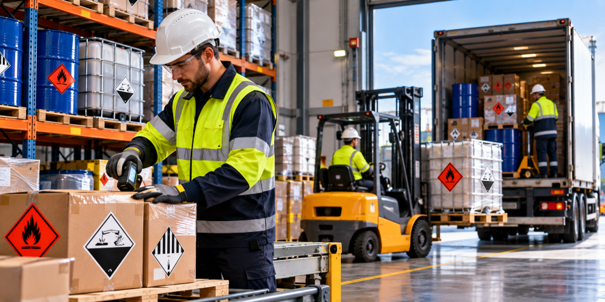
Warehouse workers can have an important role in the ADR transport chain. They may receive dangerous goods, inspect packages, prepare orders, build pallets, apply marks and labels, move drums and IBCs, load vehicles or unload incoming shipments. A mistake during any of these activities can affect the safety and compliance of the subsequent transport operation.
This raises an important question for logistics and industrial companies: what ADR training does a warehouse worker actually need?
The answer depends primarily on the employee’s function. ADR does not simply divide employees into “warehouse workers” and “drivers”. Instead, Chapter 1.3 requires people whose duties concern the carriage of dangerous goods to receive training appropriate to their responsibilities and duties.
ADR training is not only for drivers
There is an important distinction between ADR driver training and ADR training under Chapter 1.3.
Drivers who fall within the relevant ADR driver training requirements are covered by the specialised provisions of ADR Chapter 8.2. That is the familiar system associated with ADR driver training certificates.
Warehouse personnel are different. If their duties concern the carriage of dangerous goods, the training provisions in ADR Chapter 1.3 can apply to them.
ADR 1.3 requires relevant employees to be trained before they assume responsibilities involving dangerous goods. Until the required training has been provided, they may only perform functions for which they have not yet been trained under the direct supervision of a trained person.
The required training consists of several elements. Employees need general awareness of the dangerous goods requirements, function-specific knowledge directly related to their duties and appropriate safety training. Relevant security provisions must also be addressed.
This function-based principle is particularly important in a warehouse because two employees with the same job title may perform very different activities.
What does the warehouse worker actually do?
Consider two employees working in the same distribution centre.
The first employee moves sealed pallets from one storage location to another and has no responsibility for preparing dangerous goods for transport. The second employee checks packages, builds outbound pallets, verifies labels and loads those pallets onto trucks.
Calling both employees “warehouse operators” does not tell us enough about their training needs.
The second employee may perform functions that ADR identifies with participants such as the packer, loader or unloader. Those functions carry specific responsibilities. The employer should therefore determine the required training by analysing the employee’s actual activities rather than relying on the wording of the employment contract.
This is one of the most useful principles when building an ADR training programme: train according to function, not simply according to job title.
Loading dangerous goods carries real responsibilities
Loading is a good example of why warehouse personnel need appropriate ADR knowledge.
Under ADR, a loader has specific obligations. Among other things, dangerous goods should only be handed over for carriage when they are authorised for transport. When packed dangerous goods or uncleaned empty packages are handed over, the loader must check for damage to the packaging. A damaged package that is leaking, or could leak its dangerous contents, must not simply be loaded onto the vehicle.
The loader also has to comply with applicable loading and handling requirements.
Mixed loading can be another consideration. Certain dangerous goods cannot simply be loaded together without checking the applicable requirements. Separation requirements concerning foodstuffs, other articles of consumption and animal feed can also become relevant.
For the employee standing beside the truck with a forklift, these are not abstract legal concepts. They influence practical decisions made during every working day.
Warehouse employees should recognise dangerous goods
A warehouse worker does not necessarily need to become a dangerous goods classification specialist. However, employees involved in relevant functions should understand the basic structure of the ADR system.
That includes recognising the nine ADR hazard classes and understanding the purpose of hazard labels. Employees should know that a Class 3 label indicates a flammable liquid hazard, while Class 8 relates to corrosive substances and Class 9 covers miscellaneous dangerous substances and articles.
The UN number is another important concept. A four-digit UN number identifies a dangerous substance or article, or a group of substances or articles, within the transport system.
Warehouse employees should also understand the difference between transport labels and the GHS/CLP pictograms they may encounter on chemical product labels. They are related safety communication systems, but they serve different regulatory purposes and should not simply be treated as interchangeable.
Understanding these fundamentals makes it easier for employees to recognise when something is wrong.
Packaging should be part of the training
Packaging is one of the most important barriers between a dangerous substance and the people handling it.
Drums, jerricans, boxes, bags, IBCs and combination packagings used for dangerous goods may be subject to ADR packaging requirements. Depending on the dangerous goods involved, UN specification packaging may be required.
A warehouse worker involved in packing dangerous goods should therefore understand why the correct packaging matters and why apparently small changes can create compliance problems.
Using the wrong inner packaging, exceeding permitted quantities, failing to close a drum correctly or using damaged packaging can compromise the shipment.
The same principle applies to reused packaging. An empty drum that previously contained dangerous goods cannot automatically be treated as an ordinary empty container. Uncleaned empty packaging can remain subject to dangerous goods requirements.
Training helps warehouse personnel understand why these rules exist instead of simply teaching them to follow a checklist.
Limited Quantities still require knowledge
Limited Quantities are particularly relevant to warehouses handling consumer and industrial products.
Paints, adhesives, aerosols and many other products can sometimes be transported under ADR Limited Quantity provisions when the applicable conditions are met. This can provide significant regulatory relief.
However, Limited Quantity does not mean “not dangerous goods”.
The permitted quantity depends on the specific dangerous good. Packaging requirements apply and packages must carry the appropriate Limited Quantity mark where required. Other provisions can also remain relevant.
Warehouse workers preparing Limited Quantity shipments therefore need enough knowledge to recognise that the exemption is conditional. They should not simply apply an LQ mark because a particular product was shipped that way previously.
The 1,000-point exemption matters in dispatch operations
Another ADR concept relevant to many warehouses is the exemption associated with quantities carried per transport unit under ADR 1.1.3.6, often referred to operationally as the “1,000-point rule”.
Depending on the dangerous goods and quantities loaded, this provision can reduce some of the requirements that would otherwise apply to the transport operation.
But it is not a general exemption from ADR.
Warehouse and dispatch personnel involved in determining quantities or preparing loads need to understand when the provision can be used and what requirements continue to apply. Incorrectly assuming that a shipment is “under 1,000 points” can result in the vehicle leaving the site under the wrong conditions.
This illustrates why awareness training should provide employees with more than a collection of hazard symbols. They need to understand the decisions that affect their own work.
Loading and unloading should be covered
Unloading also creates responsibilities.
Personnel may need to verify that the correct goods are being unloaded and take appropriate precautions during handling. Damage, leakage or other irregularities should trigger the company’s incident procedures rather than routine unloading.
Employees should know what to do when they encounter a leaking drum, damaged IBC or suspicious package.
Safety training under ADR should address the hazards presented by dangerous goods, including appropriate actions in the event of an incident. This should then be supplemented by workplace-specific instruction covering emergency arrangements, spill response procedures, PPE and internal reporting.
Online ADR training can provide the regulatory foundation, but it does not replace site-specific practical instruction.
ADR training and general warehouse safety are not the same thing
Another important distinction is the difference between transport compliance and general occupational safety.
A warehouse containing dangerous substances may be subject to additional requirements concerning chemical exposure, fire safety, storage, explosion hazards and environmental protection. These requirements can arise from national legislation and European frameworks such as CLP and occupational safety legislation.
ADR primarily concerns the transport of dangerous goods.
Consequently, completing an ADR Awareness course does not automatically mean that every training requirement associated with working in a chemical warehouse has been fulfilled.
Companies should combine the relevant training elements. An employee may need ADR training because they prepare dangerous goods for transport while also requiring separate instruction covering storage procedures, emergency response, PPE and other workplace hazards.
Online ADR training for warehouse personnel
For warehouses with multiple shifts, temporary staff or operations in several European countries, e-learning can provide a practical way to deliver consistent ADR knowledge.
YourSafetyStore.eu offers the E-learning ADR Awareness 1.3 (English) specifically for personnel involved in the dangerous goods transport chain. The course addresses ADR functions, classification, labels, packaging and other practical subjects relevant to dangerous goods operations.
It is particularly relevant to employees performing functions such as packing, loading and unloading. The online format also allows employees to complete the theoretical component without an entire warehouse shift having to be taken out of operation at the same time.
For employees whose work is focused more broadly on handling and working with dangerous substances inside a warehouse, YourSafetyStore.eu also offers an Awareness Dangerous Goods course. This covers subjects including storage and transport legislation, GHS and ADR/IMDG classification, Safety Data Sheets, dangerous goods handling and spill management.
The employer should select the training that corresponds with the employee’s actual responsibilities.
Make ADR competence part of warehouse operations
ADR compliance works best when it becomes part of normal warehouse processes rather than a final check immediately before a vehicle departs.
Receiving, storage, order picking, packing, palletising, labelling, documentation and loading are connected steps. Employees making decisions during those steps should understand how their actions can affect the dangerous goods shipment.
That is why ADR training for warehouse workers matters.
The objective is not to turn every warehouse employee into a dangerous goods safety adviser. It is to ensure that employees understand the rules relevant to their own functions, recognise when something is wrong and know when they need to stop and ask for specialist assistance.
For European warehouses handling dangerous goods, the ADR Awareness 1.3 online training available through YourSafetyStore.eu provides a practical foundation for employees involved in packing, loading, unloading and other transport-related activities.
A safe dangerous goods journey does not start when the truck enters the public road. It starts inside the warehouse, with the people who prepare the shipment.
