
ADR vs IMDG: What Changes When Dangerous Goods Go by Sea?
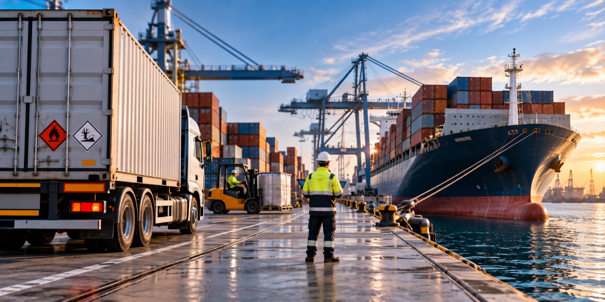
A shipment of dangerous goods leaves a factory in Germany by truck and travels to Rotterdam. From there, the container is loaded onto a vessel bound for Singapore. The substance inside the packages has not changed, the UN number is still the same and the physical hazards remain the same. Nevertheless, the regulatory framework changes significantly during the journey.
For the road section in Europe, ADR is normally the principal international dangerous goods regulation. Once the shipment is prepared for carriage by sea, the International Maritime Dangerous Goods Code – better known as the IMDG Code – becomes essential.
This can create a dangerous assumption in logistics operations: if a shipment complies with ADR, it must automatically comply with IMDG. Although ADR and IMDG are closely related and are both based largely on the United Nations system for the transport of dangerous goods, they are not identical. Classification, documentation, marking, segregation, marine pollutants, container requirements and training all require attention when dangerous goods move from road to sea.
The same UN system, but a different transport environment
ADR and the IMDG Code share a common foundation. Both use UN numbers, Proper Shipping Names, dangerous goods classes, packing groups, labels and UN-approved packaging systems. A drum containing UN 1993 FLAMMABLE LIQUID, N.O.S., for example, does not suddenly become a completely different dangerous good because it is placed on a ship.
That common structure is extremely useful for international logistics. It allows dangerous goods to move between different transport modes without an entirely new classification system having to be created for each part of the journey.
However, each mode of transport has its own operating environment and therefore its own additional risks.
Road transport takes place relatively close to emergency services and usually involves comparatively short transport units. A container vessel may carry thousands of containers, remain at sea for weeks and operate hundreds of kilometres from land. If a fire, leakage or chemical reaction develops inside a freight container, access can be extremely difficult.
The IMDG Code therefore contains maritime requirements that do not simply duplicate ADR.
The current mandatory edition is the IMDG Code 2024 Edition incorporating Amendment 42-24, which became mandatory on 1 January 2026. Companies shipping dangerous goods by sea must therefore make sure that their procedures and training reflect the applicable maritime requirements.
Classification may look familiar, but check the IMDG entry
One of the first mistakes companies can make is copying information directly from an ADR transport document into maritime documentation without checking the corresponding IMDG Dangerous Goods List entry.
Both systems use the familiar nine dangerous goods classes, ranging from explosives and gases to flammable liquids, corrosive substances and miscellaneous dangerous substances. The same UN number will normally remain associated with the substance or article.
That does not mean all transport conditions are identical.
The Dangerous Goods List in Chapter 3.2 of the IMDG Code contains information relevant specifically to maritime transport, including packing provisions, tank instructions, EmS information, stowage and handling provisions and segregation requirements.
Consequently, the correct question is not simply: “Is this product ADR classified?”
The better question is: “What are the applicable requirements for this UN number under the transport mode we are about to use?”
That distinction becomes especially important for multimodal shipments.
Marine pollutants are an important difference
One of the most visible differences when moving from ADR to maritime transport concerns marine pollutants.
The marine environment is obviously central to maritime regulation. Certain substances are identified under the IMDG Code as marine pollutants, and the maritime documentation, marking and handling requirements must therefore be considered.
A company accustomed to European road transport should not assume that the environmental provisions it normally applies under ADR can simply be copied to a sea shipment without verification. The applicable entry and characteristics of the substance must be checked against the IMDG requirements.
This is particularly important for chemical manufacturers and distributors exporting products from Europe. A shipment that routinely travels by truck between European warehouses may require additional attention when the same product is exported in a freight container.
The environmental hazard of the substance has not changed. The regulatory consequences associated with transporting that substance at sea may have.
Documentation changes when the shipment goes to sea
Documentation is another area where road and sea transport should not be treated as interchangeable.
ADR establishes requirements for the dangerous goods transport document used during road carriage. Maritime shipments similarly require dangerous goods information in accordance with the IMDG Code, but the sea transport process has its own documentation requirements and declarations.
The shipper or consignor therefore needs to ensure that the dangerous goods description is correct for the maritime shipment. This typically involves elements such as the UN number, Proper Shipping Name, class and, where applicable, subsidiary hazard and packing group. Other information may also be required depending on the substance and circumstances.
When dangerous goods are packed into a container or vehicle, container or vehicle packing certification requirements can also become relevant. This is particularly significant because the carrier and vessel operator depend heavily on information supplied before the container reaches the ship.
An incorrect declaration is not simply an administrative mistake. If dangerous goods are incorrectly declared, the vessel operator may not have the information needed to make appropriate decisions about stowage and segregation.
Segregation becomes particularly important at sea
Segregation is one of the areas in which personnel familiar with ADR need to develop specific IMDG knowledge.
Dangerous goods that can react dangerously with each other must be kept appropriately separated. At sea this is particularly important because a ship contains a large concentration of cargo in a relatively confined environment.
The IMDG Code contains detailed segregation provisions and terminology. Depending on the substances involved, dangerous goods may need to be separated from other dangerous goods according to prescribed segregation requirements.
There are also specific segregation groups covering substances with particular chemical characteristics. The purpose is to prevent incompatible substances from being placed in positions where leakage, fire or package damage could lead to a dangerous interaction.
This cannot safely be managed by looking only at the hazard labels on two packages. Personnel responsible for maritime dangerous goods need to understand how to determine the applicable segregation requirements from the IMDG Code.
A freight container creates another compliance layer
The transition from road to sea frequently involves a freight container, and that container should never be regarded simply as a large box into which compliant ADR packages can be placed.
The packages themselves must be suitable for the dangerous goods concerned, correctly closed and appropriately marked and labelled. The cargo must then be packed and secured so that it can withstand the conditions reasonably expected during transport.
At sea, containers can experience vessel movement, vibration, temperature changes and substantial forces. Poor cargo securing can allow packages to move, fall or become damaged. A small leakage inside a closed container can subsequently create a much larger problem before anyone becomes aware of it.
The Cargo Transport Units Code, or CTU Code, provides additional internationally recognised guidance for the safe packing of cargo transport units. For organisations regularly stuffing containers, understanding correct cargo securing, load distribution and packing practice should therefore form part of the broader safety system.
Once the container contains dangerous goods, the required placards, marks and other external identification must also be considered under the IMDG Code.
Limited quantities do not mean “no dangerous goods rules”
Limited Quantity shipments are another common source of misunderstanding.
Both ADR and IMDG provide relief for dangerous goods packed in limited quantities, but “Limited Quantity” does not mean that the goods have ceased to be dangerous goods. Packaging conditions, quantity limits, marks and other applicable requirements still have to be observed.
Companies should therefore avoid using their ADR Limited Quantity procedure automatically for an export shipment without checking the maritime provisions.
The same principle applies more broadly: exemptions and simplified provisions are mode-specific. A relief available during one stage of transport should never simply be assumed to apply in exactly the same way during the next stage.
ADR training is not automatically IMDG training
Perhaps the most important operational difference concerns people.
An employee may have excellent ADR knowledge but still require additional training before performing functions relating to dangerous goods transported by sea. The IMDG Code contains training provisions for shore-based personnel whose duties concern the transport of dangerous goods.
The training required should correspond with the employee’s responsibilities. A person classifying dangerous goods needs different detailed knowledge from someone packing packages into a container, preparing dangerous goods information or handling cargo at a terminal.
This is why companies involved in maritime exports should consider IMDG training separately from their ADR training programme.
For employees who need general knowledge of maritime dangerous goods requirements, YourSafetyStore.eu provides online IMDG Code Awareness training. Companies can also select more function-specific training where employees have particular responsibilities in the maritime chain.
For example, employees acting as consignors or freight forwarders can follow the E-learning IMDG Code Consignor Course (English) available through YourSafetyStore.eu. The course is specifically aimed at personnel involved in forwarding or consigning dangerous goods intended for carriage by sea and covers subjects including the IMO framework, classification, labels, packing groups and maritime dangerous goods requirements.
This distinction between awareness and function-specific competence is important. Training should correspond to what the employee actually does.
Multimodal transport requires multimodal knowledge
For many European businesses, the real challenge is that ADR and IMDG do not operate separately. They meet every day.
A container may leave a chemical plant by road, enter a port terminal, travel by sea and subsequently continue by road in another country. The logistics process is one continuous movement, but several regulatory regimes can apply during that journey.
Companies should therefore identify the transition between transport modes during shipment planning rather than waiting until the container arrives at the port.
Classification should be checked, maritime documentation prepared, package and container marks verified, segregation considered and the appropriate employees trained before dispatch. Doing this early reduces the risk of containers being delayed or rejected at terminals and, more importantly, reduces the risk of dangerous goods being transported under incorrect conditions.
From European road transport to global maritime transport
ADR knowledge provides an excellent foundation for people involved in dangerous goods logistics in Europe. The terminology of UN numbers, classes, packing groups, labels and packaging creates substantial common ground with the IMDG Code.
But common ground should not be confused with identical requirements.
As soon as dangerous goods enter the maritime transport chain, companies must consider the specific requirements of the IMDG Code. Marine pollutants, maritime documentation, container packing, stowage and segregation are among the subjects that can require a different approach.
European companies that export dangerous goods should therefore build their competence around the complete transport chain. YourSafetyStore.eu offers both ADR Awareness training for employees involved in road transport and a range of IMDG / Sea Transport courses, allowing organisations to select training according to the transport mode and actual function of the employee.
The practical rule is simple: when the transport mode changes, do not assume the dangerous goods requirements remain unchanged. Check the applicable code, check the shipment and make sure the people making the decisions understand the difference.
