
Chemical Logistics Safety Standards: Key Requirements
Chemical logistics is considerably more complex than moving ordinary cargo from one location to another. A single shipment may involve hazardous substances leaving a production facility, temporary storage in a warehouse, loading into a tank truck or freight container, road transport to a terminal and subsequent movement by sea, rail or inland waterway. At every stage, people, equipment, packaging and procedures have to work together.
This creates an important question for companies operating in the chemical supply chain: which safety standards actually apply?
There is no single international “chemical logistics safety standard” covering every activity. Instead, chemical logistics operates within a network of transport regulations, occupational safety legislation, environmental requirements, technical standards and company procedures. Understanding how these systems interact is essential for manufacturers, warehouses, tank terminals, carriers, freight forwarders and distributors.
Dangerous goods regulations form an important foundation
For dangerous goods transport in Europe, one of the most important frameworks is ADR. The current ADR 2025 provisions apply to international carriage of dangerous goods by road and establish detailed requirements concerning classification, packaging, tanks, documentation, marking, labelling, vehicles, loading, unloading and the responsibilities of participants.
The system is built around the hazards presented by the goods.
Dangerous substances and articles are allocated to one of nine dangerous goods classes. A UN number and Proper Shipping Name identify the substance or article for transport purposes, while additional information such as packing group and subsidiary hazards can determine how the product must be packaged and transported.
Correct classification is therefore the starting point of safe chemical logistics.
If a product is incorrectly classified, the error can continue throughout the entire logistics chain. The wrong packaging may be selected, labels may be incorrect, transport documentation can contain incorrect information and the carrier may not know the actual hazards present.
Safety consequently begins long before a truck arrives at the loading bay.
ADR is only one part of the international system
Chemical logistics frequently involves several modes of transport.
Road transport in Europe is primarily governed by ADR, while RID applies to international rail transport and ADN covers inland waterways. Dangerous goods transported by sea fall under the International Maritime Dangerous Goods Code, or IMDG Code. Air transport is governed through the ICAO framework and the operational dangerous goods requirements commonly encountered through the IATA Dangerous Goods Regulations.
These systems share many fundamental concepts. UN numbers, dangerous goods classes, hazard labels and packing groups provide an internationally recognisable structure.
However, the regulations are not identical.
A shipment prepared correctly for road transport cannot automatically be assumed to meet every requirement for maritime or air transport. Quantity limitations, packaging, documentation, marks and labels, segregation requirements and modal restrictions may differ.
Companies operating internationally therefore need procedures that recognise the transition from one transport mode to another.
Packaging is a primary safety barrier
Chemical logistics safety depends heavily on packaging integrity.
Drums, jerricans, boxes, bags, IBCs, large packagings and tanks prevent dangerous substances from being released during normal transport and handling. Depending on the dangerous goods involved, the packaging may have to meet UN performance requirements and be used according to applicable packing instructions.
This makes packaging much more than a purchasing decision.
Employees need to understand that a UN-approved package is approved for specified conditions. Using an unsuitable inner packaging, exceeding permitted capacity, incorrectly closing a drum or continuing to use damaged packaging can undermine the entire safety system.
The same principle applies to empty uncleaned packaging. A drum that has been emptied but still contains dangerous residues cannot necessarily be treated as an ordinary empty drum. Transport requirements can continue to apply until the packaging has been adequately cleaned or otherwise made safe.
Warehouses and loading locations therefore need procedures for checking package condition before dangerous goods enter the transport chain.
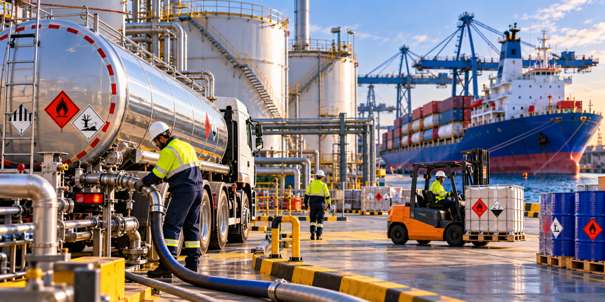
Loading and unloading are high-risk interfaces
Many chemical logistics incidents occur not while a vehicle is travelling but while substances are being transferred.
Loading and unloading combine people, vehicles, hoses, valves, pumps and potentially large quantities of hazardous chemicals in one location. A mistake can result in a spill, chemical exposure, fire, environmental release or dangerous reaction.
Tank truck operations deserve particular attention.
Before loading or unloading begins, the parties involved should know exactly which product is being transferred, which tank or compartment is involved and where the product is going. Connections must be correct, equipment suitable and relevant protective measures in place.
Communication between the driver and site operator is critical.
A strong procedure should define responsibilities before the transfer starts, during the operation and when it is completed. Emergency arrangements should also be clear before an incident occurs.
For companies involved in bulk chemical transport, YourSafetyStore.eu offers the E-learning Loading and Unloading of Chemical Tank Trucks (English). The course addresses transport procedures, the functions and duties associated with loading and filling, PPE and possible incidents during chemical tank truck operations.
It can therefore be used as part of a broader competence programme for drivers, operators and personnel supervising loading and unloading activities.
Chemical storage requires another layer of control
Transport rules should not be confused with storage rules.
ADR primarily addresses the carriage of dangerous goods and activities directly associated with that transport. Once chemicals are stored at a warehouse or production site, additional national and European occupational, fire safety and environmental requirements can become relevant.
A chemical warehouse should therefore be designed and operated according to the hazards actually present.
Important issues can include fire resistance, spill containment, ventilation, emergency access, separation of incompatible chemicals, firefighting arrangements and restrictions on ignition sources.
Segregation is particularly important.
Flammable liquids should not simply be stored according to available floor space. Acids, alkalis, oxidising substances, toxic chemicals and other hazardous materials may require separation because accidental contact can cause heat generation, fire, toxic gases or other dangerous reactions.
The Safety Data Sheet is an important source of information, but safe storage requires a systematic risk assessment rather than merely placing SDS documents in a folder.
Explosion safety can become part of chemical logistics
Flammable liquids, gases and combustible dusts can create explosive atmospheres.
Where such atmospheres may occur, European companies can encounter the ATEX framework. Employers need to assess explosion risks and implement appropriate organisational and technical measures. Hazardous areas may need to be classified into zones and equipment used within those zones must be appropriate for the conditions concerned.
This is particularly relevant around filling installations, pumps, tank connections, chemical processing areas and locations where flammable vapours can be released.
Employees also need to understand the basic principles of explosion safety.
YourSafetyStore.eu offers ATEX Awareness training in several languages for employees who work in or may come into contact with potentially explosive environments. The training covers the development of explosion hazards, recognition of dangerous situations, relevant legislation and explosion-protected equipment.
ATEX training and ADR training therefore serve different purposes but can complement each other within a chemical logistics operation.
Occupational safety remains essential
Dangerous goods regulations should never be regarded as a replacement for workplace safety management.
A warehouse worker handling corrosive chemicals may need ADR knowledge because those products are being prepared for transport, but the employer must also control the employee’s exposure during normal work.
The same applies to confined spaces, working at height, maintenance activities, chemical sampling and cleaning operations.
Risk assessment provides the connection between these different safety disciplines. Companies should identify hazards, determine who may be exposed, assess the likelihood and consequences of incidents and implement measures according to the hierarchy of controls.
Personal protective equipment is important, but PPE should not become the first or only safety measure considered.
Where possible, risks should first be eliminated or reduced through engineering, equipment design, containment, automation and organisational measures.
Training should follow the employee’s function
One of the recurring principles across chemical logistics is competence.
Employees should understand the risks and regulatory requirements relevant to the work they actually perform. This means training should be function-oriented rather than based solely on job titles.
Under ADR, for example, employees whose duties concern dangerous goods transport must receive training corresponding to their responsibilities. YourSafetyStore.eu offers an ADR Awareness 1.3 English course aimed at participants in the dangerous goods transport chain, including consignors, consignees, packers, fillers, loaders and unloaders.
For personnel working more generally with dangerous substances, the Awareness Dangerous Goods course covers subjects including storage and transport legislation, GHS and transport classification, Safety Data Sheets, segregation and spill management.
These courses have different purposes. Selecting the appropriate training therefore starts with identifying what the employee actually does.
Emergency preparedness completes the system
Even strong preventive measures cannot reduce risk to zero.
Chemical logistics companies therefore need to prepare for abnormal situations. A damaged IBC, leaking hose, vehicle collision, warehouse fire or incorrect chemical connection can rapidly develop into a serious incident.
Emergency procedures should answer practical questions before an event occurs.
Who raises the alarm? Who stops the transfer? Where are emergency shutdowns located? Which employees may intervene and which must evacuate? How is contaminated firewater controlled? Who contacts emergency services and what information will responders need?
Exercises and incident scenarios can expose weaknesses that remain invisible in written procedures.
Lessons from near misses are equally valuable. A coupling connected to the wrong line but discovered before transfer is not simply “nothing happened”. It is information about a failure mechanism that could produce a serious accident next time.
From compliance to a chemical logistics safety system
The strongest chemical logistics operations do not manage ADR, occupational safety, ATEX, storage and emergency response as completely separate subjects.
They connect them.
Classification determines how a chemical is packaged and communicated. Packaging protects it during handling and transport. Warehouse controls reduce the probability of fire, leakage and incompatible reactions. Loading procedures protect the interface between facility and vehicle. ADR, IMDG, RID, ADN or air transport requirements govern the relevant transport stage. Training ensures that employees understand their responsibilities, while emergency planning provides resilience when preventive controls fail.
This is what chemical logistics safety standards mean in practice: not one rulebook, but a coordinated system of regulatory requirements, technical safeguards, procedures and competent people.
YourSafetyStore.eu provides online training and professional safety resources across this wider spectrum, including ADR, IMDG, IATA, ATEX, chemical tank truck, warehousing and industrial safety subjects.
For chemical logistics companies, the objective should go beyond demonstrating that individual regulations have been considered. A mature safety system connects the complete journey of the chemical – from packaging and storage through loading and transport to final unloading – and ensures that the people making decisions at every stage understand both the hazards and their responsibilities.
Because in chemical logistics, safety is only as strong as the weakest interface in the chain.
