
Dangerous Goods Training for Importers and Exporters?
Importing and exporting dangerous goods involves much more than arranging transport and preparing customs documentation. Chemicals, paints, aerosols, batteries, fuels, laboratory products and many other regulated products can enter an international transport chain in which several dangerous goods regulations apply. A shipment may leave a European factory by road under ADR, continue from Rotterdam or Hamburg by sea under the IMDG Code and, in some cases, be transported by air under the rules applicable to aviation.
For importers and exporters, this raises an important question: who needs dangerous goods training?
There is no universal course simply because somebody has the job title “importer” or “exporter”. Dangerous goods training is generally connected to the functions people actually perform. An employee who books transport has different responsibilities from someone who classifies a chemical, fills drums, packs a freight container or prepares dangerous goods transport documentation.
For companies trading internationally, understanding this distinction is essential.
Importing and exporting can create dangerous goods responsibilities
A company does not need to manufacture dangerous chemicals to become part of the dangerous goods transport chain. A distributor importing paint, a webshop exporting lithium batteries or a machinery company shipping equipment containing batteries may all become involved in regulated transport.
The first step is therefore to establish whether the products being shipped are dangerous goods for transport purposes.
The Safety Data Sheet can provide useful information, particularly Section 14, but personnel responsible for transport should understand how transport classification works rather than relying blindly on a product description. Relevant information can include the UN number, Proper Shipping Name, transport class, subsidiary hazard, packing group and environmental classification.
Once a product has been identified as dangerous goods, the company must establish which transport regulation applies.
For European road transport this will commonly be ADR. Rail transport can involve RID, inland waterways ADN, maritime transport the IMDG Code and air freight the applicable ICAO/IATA dangerous goods requirements.
International trade can therefore quickly become multimodal dangerous goods transport.
ADR training for import and export personnel
ADR Chapter 1.3 establishes training requirements for persons employed by participants in the carriage of dangerous goods whose duties concern such carriage. Training must correspond to their responsibilities and duties.
This is broader than many businesses realise.
Dangerous goods compliance is not exclusively the responsibility of the truck driver. Employees working for consignors, carriers, consignees, loaders, packers, fillers and other participants can perform functions that affect transport safety.
ADR training consists of several important elements. Personnel need general awareness of dangerous goods transport requirements, function-specific training relevant to their responsibilities and safety training concerning the hazards involved. Security provisions can also be relevant.
This means that an export employee responsible for preparing shipments should understand the requirements that directly affect that task. Someone responsible only for receiving goods may require a different level and scope of knowledge.
An important principle is that personnel should receive the required training before independently assuming responsibilities covered by those provisions.
Companies looking for a practical introduction to these requirements can use the ADR Awareness 1.3 online training available through YourSafetyStore.eu. For international organisations, providing training in languages employees understand can also help ensure that the regulatory concepts are understood rather than merely memorised.
Exporting by sea introduces the IMDG Code
European exporters frequently encounter another regulatory transition at the port.
Imagine that a manufacturer in Belgium prepares a pallet of dangerous goods for a customer in South Africa. The goods first travel by truck to Antwerp. ADR applies to the European road movement, but the maritime stage introduces the International Maritime Dangerous Goods Code.
The IMDG Code is specifically designed for dangerous goods transported by sea. Its structure has much in common with ADR because both systems are based on the international UN dangerous goods framework. Nevertheless, the requirements are not identical.
Export personnel may need to consider maritime classification provisions, packaging, marking and labelling, documentation, marine pollutants, segregation and container packing requirements.
This makes IMDG knowledge particularly important for exporters, freight forwarders and other personnel involved in preparing dangerous goods for maritime shipment.
The current IMDG Code 2024 Edition incorporating Amendment 42-24 became mandatory on 1 January 2026. Companies regularly exporting dangerous goods by sea should therefore make sure their procedures and employee knowledge correspond with the applicable edition.
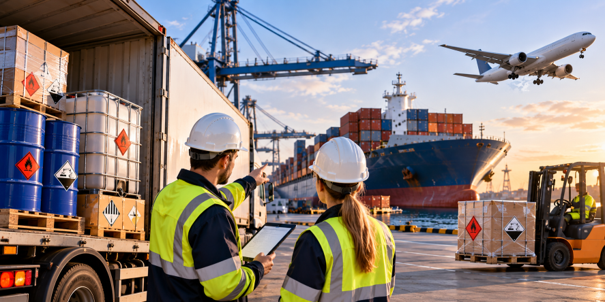
Packing a container is a safety-critical function
One area that deserves particular attention is container packing.
A dangerous goods package that complies with the applicable packaging requirements can still become part of an unsafe shipment if it is incorrectly loaded or secured inside a container. During an ocean voyage, cargo is exposed to movement, vibration and forces that can continue for days or weeks.
Packages must therefore be correctly positioned and secured. Incompatible dangerous goods may require segregation, and the person responsible for packing needs to understand which requirements apply.
External container marks and placards must also be correct where required.
These responsibilities demonstrate why a generic company induction is rarely sufficient for everyone involved in dangerous goods exports. The person actually packing the container needs knowledge directly related to that function.
For companies with personnel involved in maritime shipments, YourSafetyStore.eu offers IMDG Code training, including courses aimed at particular functions such as consignors and personnel involved in packing dangerous goods for sea transport.
Air freight requires another approach
Air transport requires still greater attention because the aviation environment introduces specific risks and restrictions.
A product that can legally travel by road or sea cannot automatically be shipped by air under the same conditions. Quantity restrictions, packaging requirements, documentation and prohibitions can differ significantly.
Dangerous goods training for air transport has increasingly moved toward a competency-based approach. Instead of deciding training requirements merely from an employee’s job title, the employer should identify the functions the person performs and determine the knowledge, skills and level of proficiency necessary to perform those functions safely.
This is particularly relevant to exporters.
Someone preparing a dangerous goods consignment for air transport has substantially different training needs from an employee who only handles general cargo. Likewise, personnel accepting dangerous goods for an airline have responsibilities different from employees who prepare the shipper’s documentation.
YourSafetyStore.eu provides IATA Dangerous Goods Awareness training for organisations that need employees to develop appropriate awareness of dangerous goods in the aviation environment. Companies should always determine whether awareness training is sufficient for the actual function or whether more comprehensive function-specific training and assessment is required.
Limited Quantities do not eliminate the need for knowledge
Importers and exporters sometimes assume that Limited Quantity shipments fall completely outside dangerous goods legislation.
That is incorrect.
Limited Quantity provisions can provide substantial regulatory relief, but the products remain dangerous goods and specified requirements continue to apply. The permitted quantity depends on the particular dangerous good and applicable transport regulation, while packaging and marking provisions still have to be observed.
The situation becomes particularly important in multimodal transport because businesses should not assume that every exemption or relief works identically under ADR, IMDG and air transport requirements.
An employee who understands why a package qualifies for Limited Quantity provisions is therefore in a much stronger position than someone who has simply been told to place a particular mark on a box.
Training should create understanding, not merely procedural repetition.
Importers should not be forgotten
Training discussions often concentrate on exporters because the exporter prepares the shipment. Importers, however, can also have significant responsibilities.
Imported dangerous goods must be received, unloaded, handled and sometimes transferred to onward transport. An importer receiving a sea container may subsequently arrange road transport to a warehouse or customer. At that point the organisation becomes involved in another stage of the dangerous goods transport chain.
Receiving personnel should also be capable of identifying obvious problems. Damaged packages, leaking containers, incorrect markings or documentation discrepancies should not simply be treated as routine logistics issues.
This becomes particularly important when products arrive from outside Europe. Packaging or documentation prepared in another jurisdiction may still have to meet the applicable international and European transport requirements for the subsequent movement.
Multimodal shipments require broader knowledge
The greatest challenge for many importers and exporters is not understanding one dangerous goods regulation but understanding where one system ends and another begins.
Consider a shipment travelling from Poland to a customer in Canada. It may first travel under ADR by truck to a European port, continue under the IMDG Code across the Atlantic and subsequently enter another national transport regime after arrival.
Employees do not necessarily need to become experts in every regulation involved. They do, however, need sufficient knowledge for their responsibilities and must recognise when specialist advice is required.
ADR explicitly addresses this reality: where the carriage of dangerous goods involves a multimodal transport operation, personnel must be aware of requirements relating to other modes of transport relevant to their work.
That is particularly significant for freight forwarders and export departments coordinating international shipments.
Build training around functions, not job titles
The most effective dangerous goods training programme starts by mapping the transport process.
Identify who classifies products, who selects packaging, who applies marks and labels, who prepares documentation, who packs containers, who books transport and who receives dangerous goods. Then determine which regulations and training requirements apply to those functions.
This approach is considerably stronger than deciding that everybody in an export department should receive exactly the same course.
A warehouse packer may need detailed practical knowledge of packaging, marks, labels and segregation. A shipping administrator may require greater knowledge of documentation. A logistics manager coordinating road and maritime transport needs to understand the interfaces between ADR and IMDG.
Training becomes more useful when it reflects those differences.
Training as part of international trade compliance
Dangerous goods compliance should ultimately be integrated into the normal import and export process rather than treated as an additional check immediately before dispatch.
Product classification, packaging, documentation and transport mode should be considered early in order fulfilment. Training the employees making those decisions reduces the likelihood of shipments being rejected, delayed or prepared incorrectly.
For European companies, YourSafetyStore.eu offers online dangerous goods and safety training covering road, sea and air transport, including ADR Awareness 1.3, IMDG and IATA-related courses. This allows companies to select training according to the transport modes and functions present within their organisation.
For importers and exporters, the central principle is straightforward: do not ask only whether your company handles dangerous goods. Ask which employees make decisions that affect the safe and compliant transport of those goods, which transport modes they work with and what knowledge they need to perform those functions correctly.
That is where an effective dangerous goods training programme begins.
