
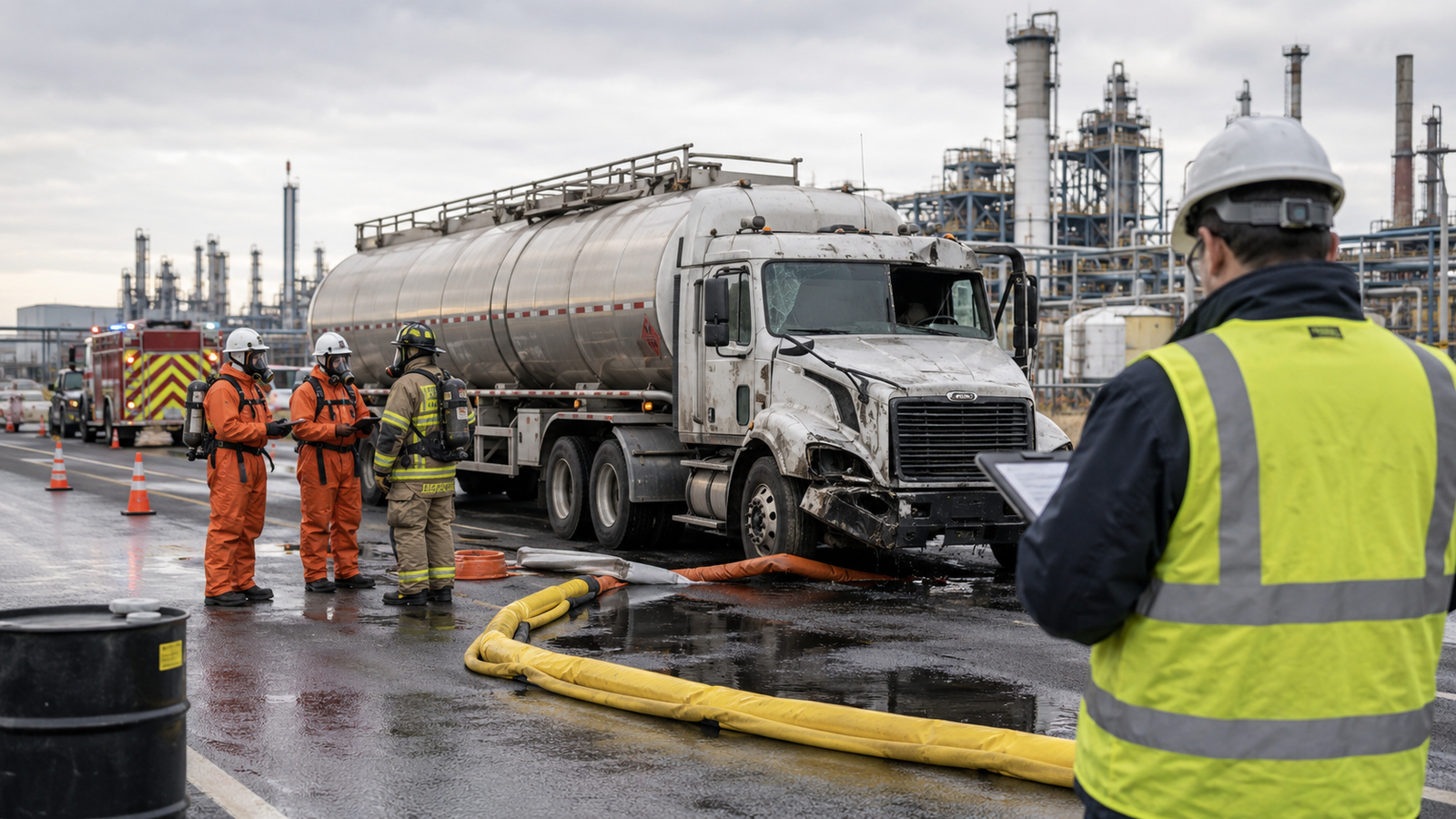
Every day, thousands of road tankers, rail tank cars, tank containers and chemical tankers transport hazardous materials across highways, rail networks and waterways around the world. The overwhelming majority of these journeys are completed without incident, reflecting decades of engineering improvements, regulatory development and professional operating standards. Yet, when a major accident does occur, the consequences can be devastating. Toxic releases, fires, explosions and environmental contamination have the potential to affect workers, emergency responders, nearby communities and critical infrastructure.
Looking for an Loading and unloading of chemical tank trucks (English) course?
Although media reports often portray these accidents as isolated events caused by a single mistake or equipment failure, official investigations consistently tell a different story. Large chemical transport accidents rarely result from one error alone. Instead, they develop through a sequence of failures involving human factors, equipment integrity, operational decision-making, organisational weaknesses and, in some cases, deficiencies in emergency response.
Recent investigations by organisations such as the U.S. National Transportation Safety Board (NTSB), the UK Marine Accident Investigation Branch (MAIB) and other national investigation authorities reveal striking similarities between seemingly unrelated accidents. Whether involving a road tanker carrying anhydrous ammonia, a rail tank car transporting vinyl chloride or a chemical tanker loaded with styrene monomer, the same underlying patterns repeatedly emerge.
Understanding these patterns is far more valuable than simply analysing individual accidents. Every serious incident provides an opportunity to strengthen safety barriers before the next accident occurs.
Looking Beyond the Immediate Cause
When a chemical transport accident makes the headlines, the first question is usually straightforward: What caused it?
However, experienced accident investigators ask a different question: Why did the event become a disaster?
There is an important distinction between the initiating event and the factors that allowed the situation to escalate. A vehicle collision, for example, may initiate an accident, but it does not necessarily explain why hazardous materials were released, why emergency responders struggled to control the incident or why fatalities occurred.
Modern accident investigation therefore focuses on the failure of safety barriers rather than identifying a single guilty party. The Swiss Cheese Model and Bow-Tie Risk Analysis have become widely accepted because they recognise that accidents occur only when multiple protective layers fail simultaneously.
The following incidents clearly demonstrate this principle.
Teutopolis (United States, 2023): When a Traffic Accident Became a Toxic Disaster
One of the most significant hazardous materials transport accidents in recent years occurred near Teutopolis, Illinois, in September 2023.
A road tanker transporting anhydrous ammonia overturned after the driver attempted to avoid a passenger vehicle that had initiated an unsafe overtaking manoeuvre. According to the official NTSB investigation, the tanker driver reacted appropriately by steering away from the approaching vehicle, but lost control of the combination, causing it to overturn.
At first glance, this appears to be a straightforward traffic accident. However, the investigation demonstrated that the rollover itself was not the primary reason for the catastrophic release.
After overturning, the pressure vessel struck a parked agricultural trailer. A protruding metal component penetrated the tank shell, creating a large rupture through which significant quantities of anhydrous ammonia escaped. The rapidly expanding toxic vapour cloud resulted in five fatalities and numerous serious injuries.
This distinction is important. The initiating event was a traffic conflict. The disaster resulted from tank penetration.
Several additional contributing factors influenced the severity of the accident.
The road offered limited recovery space, leaving the driver few options once the evasive manoeuvre began. The pressure vessel encountered an unprotected rigid object capable of puncturing the tank wall. Weather conditions favoured the formation of a dense ground-hugging ammonia cloud, while emergency responders faced significant challenges associated with identifying the hazard and operating in an extremely toxic environment.
The investigation also highlighted an issue that receives relatively little public attention. In the United States, anhydrous ammonia is transported under a hazard classification that emphasises its non-flammable characteristics. Operationally, however, ammonia behaves as one of the most dangerous inhalation hazards transported on public roads. The incident reinforced the importance of emergency planning based on actual toxic behaviour rather than regulatory classification alone.
Perhaps the most important lesson from Teutopolis is that engineers and operators should not focus exclusively on preventing rollovers. They must also consider what happens after a rollover has occurred. Objects alongside roads—including guardrails, utility poles, trailer drawbars and construction equipment—can become secondary hazards capable of compromising tank integrity.
East Palestine (United States, 2023): A Mechanical Failure Followed by Decision-Making Failures
The derailment of a Norfolk Southern freight train in East Palestine, Ohio, represents one of the most extensively investigated hazardous materials transport accidents in recent history.
Unlike Teutopolis, this accident did not begin with driver behaviour or road conditions. Instead, investigators traced the initiating event to a wheel bearing that progressively overheated before ultimately failing.
Hot-box detectors installed along the railway recorded increasing temperatures as the train travelled towards East Palestine. Unfortunately, the spacing between detectors and the alarm thresholds in use provided insufficient opportunity for the crew to stop the train before the bearing catastrophically failed.
The derailment that followed involved numerous freight cars, including several carrying vinyl chloride and other hazardous chemicals.
Again, however, the mechanical failure alone did not explain the magnitude of the disaster.
The derailment damaged older tank cars that possessed relatively limited puncture resistance compared with newer designs. Escaping flammable liquids ignited, exposing adjacent pressure tank cars to intense fire conditions.
Several days later, authorities authorised a controlled venting and burning operation involving five vinyl chloride tank cars. At the time, concerns had been raised regarding the possibility of polymerisation leading to catastrophic tank failure.
The subsequent NTSB investigation concluded that available evidence did not support the assumption that dangerous polymerisation was occurring. Temperature data, chemical analysis and engineering assessments suggested that the vinyl chloride remained stable. Investigators further concluded that critical technical information and differing expert opinions were not fully communicated to incident commanders before the decision was made.
As a result, one of the largest deliberate chemical releases in recent transport history may have been avoidable.
East Palestine therefore illustrates that accident escalation is not determined solely by engineering. Information management, communication, uncertainty assessment and emergency decision-making are equally important safety barriers.
Styrene Polymerisation on Board Stolt Groenland: When Chemistry Becomes the Hazard
Not every transport accident begins with a collision.
In September 2019, the chemical tanker Stolt Groenland suffered a violent explosion while berthed in Ulsan, South Korea. The vessel was carrying styrene monomer, a substance that requires careful temperature management throughout transportation.
Unlike many hazardous chemicals, styrene presents a unique challenge. It can undergo spontaneous polymerisation if temperature control is lost or inhibitor effectiveness decreases over time. Polymerisation is highly exothermic, meaning that it generates heat. As temperature increases, the reaction accelerates further, creating a dangerous self-sustaining process.
Investigators concluded that prolonged temperature increase gradually reduced inhibitor effectiveness. Eventually, uncontrolled polymerisation caused pressure to build inside the cargo tank until structural failure occurred.
Unlike a collision or derailment, there was no external initiating event.
Instead, the cargo itself became the source of the accident.
The investigation identified several organisational issues, including insufficient monitoring of cargo temperature, inadequate appreciation of transport duration limits, unclear responsibilities between parties involved in the shipment and delayed recognition of warning signs indicating that polymerisation had begun.
This accident demonstrates an often-overlooked reality within hazardous materials logistics.
For reactive chemicals, the cargo tank is not merely a transport container—it functions as a temporary chemical reactor. Process safety principles therefore remain just as relevant during transportation as they are inside chemical manufacturing facilities.
